Description
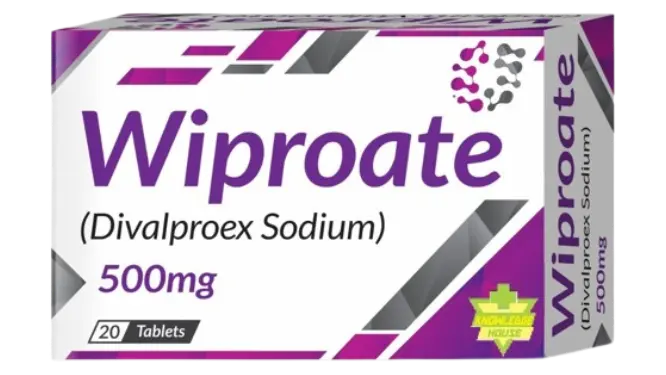
Wiproate 500mg
Description
Divalproex sodium is a stable coordination compound of sodium valproate and valproic acid.
Indications
Divalproex sodium is a versatile medication with several approved indications.
- Epilepsy: It is used as both monotherapy and adjunctive therapy for the treatment of complex partial seizures, simple and complex absence seizures, and other seizure types that include absence seizures.
- Bipolar Disorder: It is indicated for the treatment of manic episodes associated with bipolar disorder and is also used for the long-term management of the condition.
- Migraine Prophylaxis: It is used for the prevention of migraine headaches.
It is not intended for the acute treatment of a migraine attack.
Mechanism of Action
The mechanism of action of divalproex sodium is complex and multi-faceted, involving several pathways that modulate neuronal excitability.
- GABA Enhancement: One of the primary mechanisms is the enhancement of the inhibitory neurotransmitter gamma-aminobutyric acid (GABA).
Valproate is believed to increase GABA levels in the brain by:
-
- Inhibiting the enzyme GABA transaminase (GABA-T), which is responsible for breaking down GABA.
- Inhibiting the enzyme GABA transaminase (GABA-T), which is responsible for breaking down GABA.
-
- Stimulating the enzyme glutamic acid decarboxylase (GAD), which is responsible for synthesizing GABA from glutamate.
- Potentially blocking GABA reuptake into glial and nerve endings.
-
- This increase in GABA enhances inhibitory signaling, which helps to suppress the excessive neuronal firing that causes seizures.
- This increase in GABA enhances inhibitory signaling, which helps to suppress the excessive neuronal firing that causes seizures.
- Voltage-Gated Sodium Channel Blockade: Valproate is also thought to work by inhibiting voltage-gated sodium channels.
By blocking these channels, it reduces the entry of sodium ions into neurons, which decreases neuronal excitability and prevents the rapid, repetitive firing of neurons that is characteristic of seizure activity.
- Other Effects: Valproate also has other potential mechanisms that may contribute to its effects, including:
- Modulation of voltage-gated potassium and calcium channels.
- Modulation of voltage-gated potassium and calcium channels.
-
- Inhibition of histone deacetylase (HDAC) enzymes, which may lead to changes in gene expression related to mood and neuronal function.
- Inhibition of histone deacetylase (HDAC) enzymes, which may lead to changes in gene expression related to mood and neuronal function.
-
- Downregulation of protein kinase C (PKC) proteins, which are thought to be overactive in bipolar disorder.
- Downregulation of protein kinase C (PKC) proteins, which are thought to be overactive in bipolar disorder.
Reviews
There are no reviews yet.