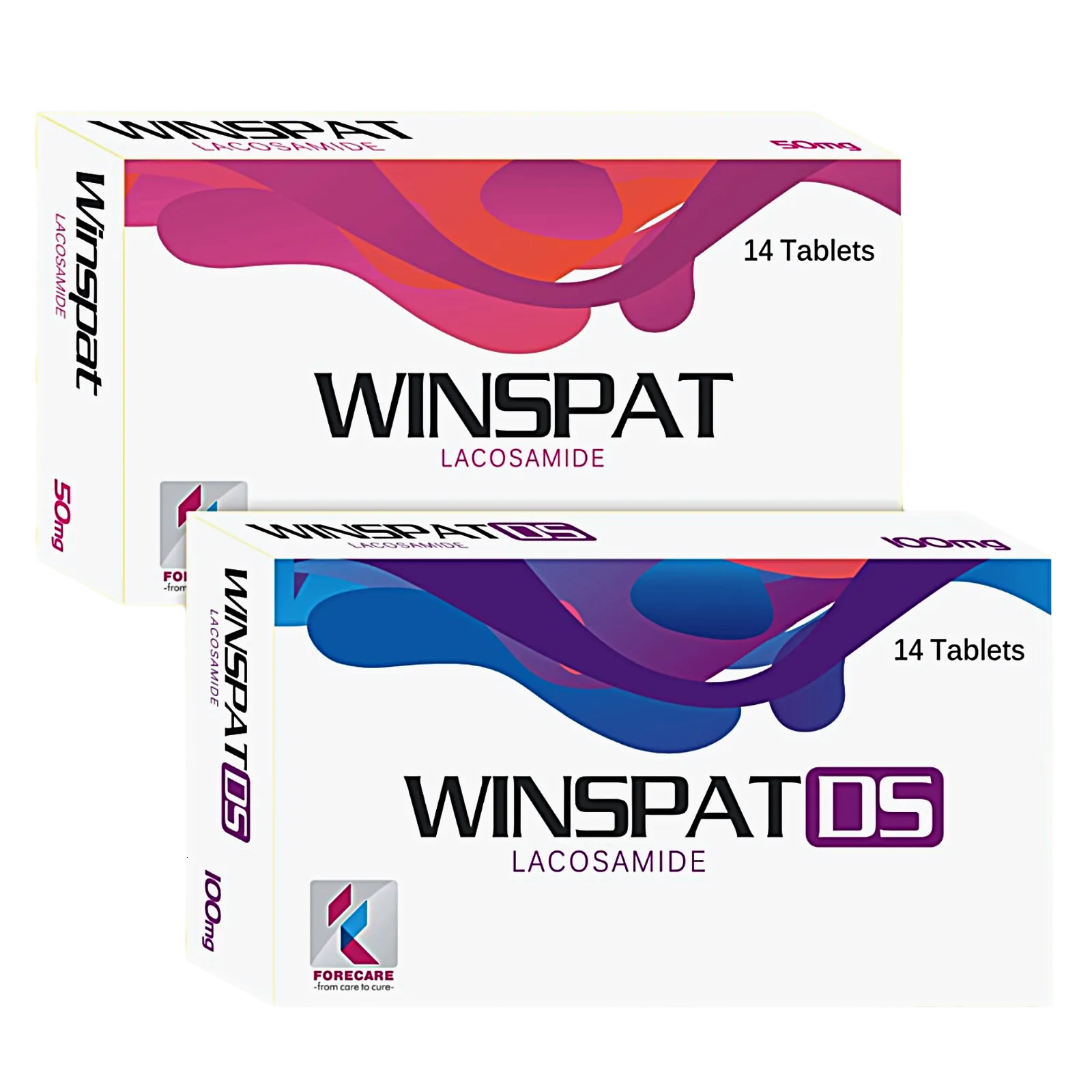
Description
Winspat
Description
Lacosamide, sold under the brand name Vimpat®, is an anticonvulsant medication used to treat certain types of seizures.
Indications
Lacosamide is primarily indicated for the treatment of partial-onset seizures in patients with epilepsy.
- Monotherapy: It is used as a single medication for the treatment of partial-onset seizures in adults and children 4 years of age and older.
- Adjunctive Therapy: It is also used as an add-on medication for partial-onset seizures in adults and children 4 years of age and older who are not fully controlled on other antiepileptic drugs.
Mechanism of Action
Lacosamide’s mechanism of action is unique among antiepileptic drugs and involves a selective enhancement of sodium channel inactivation.
- Sodium Channels: Voltage-gated sodium channels are crucial for the generation and propagation of action potentials (electrical signals) in neurons.
When a neuron is excited, these channels open, allowing sodium ions to rush into the cell, which causes depolarization and the firing of an action potential. After firing, the channels enter a state of inactivation, which prevents them from opening again immediately. This allows the neuron to return to its resting state. - Hyperexcitability in Epilepsy: In patients with epilepsy, neurons can become hyperexcitable, meaning they fire excessively and repetitively.
This is often due to a disruption in the normal functioning of ion channels, including sodium channels. - Lacosamide’s Action: Lacosamide selectively enhances the “slow” inactivation of voltage-gated sodium channels.
Unlike many other AEDs that affect “fast” inactivation, lacosamide’s action is unique. By promoting this slow inactivation, it stabilizes the neuron’s membrane and prevents the sustained, repetitive firing that is characteristic of a seizure. - Key Distinction: The unique feature of lacosamide’s action is that it selectively affects neurons that are in a depolarized or active state, which are the ones involved in seizure activity. It does not significantly affect sodium channels in resting neurons, which is thought to be the reason for its favorable side-effect profile compared to some other sodium channel-blocking AEDs.
In summary, lacosamide works by a targeted and selective action on voltage-gated sodium channels to reduce the hyperexcitability of neurons, thereby preventing the spread of seizure activity without causing widespread central nervous system depression.

Reviews
There are no reviews yet.