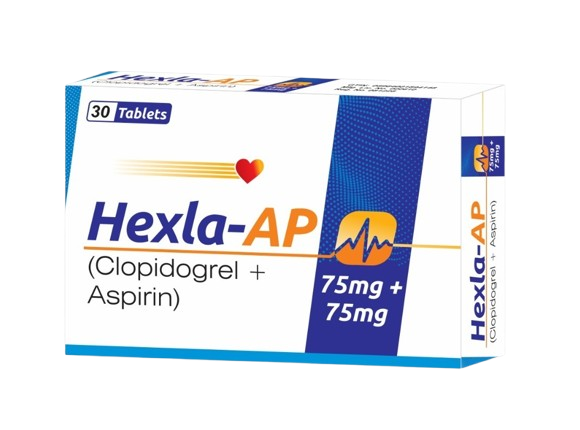
Description
Hexla
-
Description
Clopidogrel (as Bisulphate) is an oral medication that acts as an antiplatelet agent.
It is used to prevent the formation of blood clots, which can lead to serious cardiovascular events. It is a prodrug, meaning it is converted into its active form in the body. The bisulphate salt form is used for stability and bioavailability. Indications
Clopidogrel is primarily indicated for reducing the risk of thrombotic events in patients with a history of:
- Recent myocardial infarction (MI), also known as a heart attack.
- Recent stroke.
- Established peripheral arterial disease (PAD).
- Acute Coronary Syndrome (ACS): It is often used in combination with aspirin to prevent blood clots in patients with unstable angina or a recent heart attack.
- Post-stenting: It is a crucial part of dual antiplatelet therapy after the placement of a coronary stent to prevent blood clots from forming on the stent, which could lead to a heart attack.
Mechanism of Action
Clopidogrel’s antiplatelet effect is a result of its ability to inhibit a specific receptor on the surface of platelets.
- Metabolic Activation: Clopidogrel is a prodrug.
After it is absorbed, it is metabolized by a specific liver enzyme system (primarily cytochrome P450 2C19, or CYP2C19) into its active metabolite.
- Irreversible Receptor Blockade: The active metabolite of clopidogrel then irreversibly binds to the P2Y12 receptor on the surface of platelets.
- Inhibition of Platelet Aggregation: The P2Y12 receptor is a crucial part of the pathway that causes platelets to aggregate (clump together) and form a blood clot.
By blocking this receptor, clopidogrel prevents the activation of the GPIIb/IIIa complex, which is the final common pathway for platelet aggregation.
- Sustained Effect: Because the binding is irreversible, the antiplatelet effect lasts for the entire lifespan of the platelet (approximately 7-10 days). This means that for the drug’s effect to subside, new, uninhibited platelets must be produced by the body.
In essence, clopidogrel makes the platelets “slippery” and less likely to stick to each other or to the walls of blood vessels, thereby preventing the formation of dangerous blood clots.
- Recent myocardial infarction (MI), also known as a heart attack.
Reviews
There are no reviews yet.