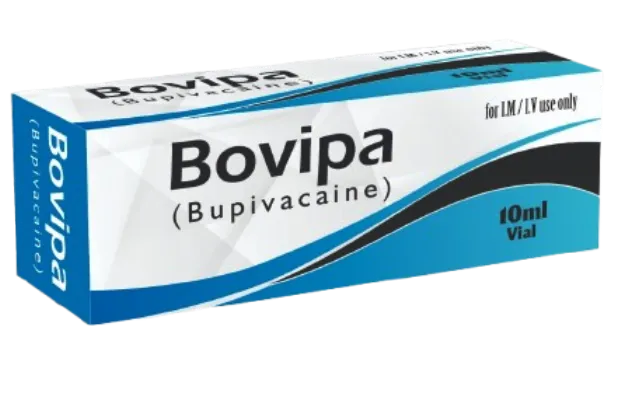
Description
Bovipa (Bupivacaine)
-
Description
Bupivacaine HCl is a potent local anesthetic medication that belongs to the amino-amide class.
It is used to produce a loss of sensation in a specific, localized area of the body. Bupivacaine is known for its long duration of action compared to other local anesthetics like lidocaine, making it particularly useful for procedures where prolonged pain relief is needed. It is available as a sterile solution for injection. -
Indications
Bupivacaine is used for various procedures where local or regional anesthesia is required.
The main indications include: - Surgical Anesthesia: To numb a specific area for surgery.
- Postoperative Pain Management: To provide long-lasting pain relief after surgery.
- Labor and Delivery: It is a commonly used medication for epidural and caudal blocks during childbirth to manage labor pain.
- Peripheral Nerve Blocks: It is injected around a specific nerve to numb the area it supplies, for example, for dental procedures or limb surgery.
- Spinal Anesthesia: It can be injected into the subarachnoid or epidural space of the spine to produce anesthesia for lower body surgical procedures.
Mechanism of Action
Bupivacaine works by blocking the generation and conduction of nerve impulses, thereby preventing the transmission of pain signals to the brain.
Its mechanism of action is centered on its interaction with voltage-gated sodium channels. - Sodium Channels and Nerve Impulses: Neurons (nerve cells) transmit electrical signals, or action potentials, by the rapid influx of sodium ions (
Na+) into the cell through voltage-gated sodium channels. This influx of positive ions causes the nerve cell to depolarize and propagate the electrical signal along the nerve fiber.
- Bupivacaine’s Action: As a local anesthetic, bupivacaine enters the nerve fiber and binds to the intracellular portion of the voltage-gated sodium channel.
By binding to this site, it physically blocks the channel, preventing sodium ions from entering the cell. - Resulting Effect: With the sodium channels blocked, the nerve cell cannot depolarize and generate an action potential.
This effectively stops the initiation and conduction of the pain signal. Since the signal cannot be transmitted, the person does not feel pain in the area that has been affected by the drug.
A key feature of bupivacaine is its high lipid solubility and its slow rate of dissociation from the sodium channel, which is why it has a longer duration of action compared to other local anesthetics.
This prolonged effect makes it an excellent choice for procedures where extended pain relief is necessary. - Postoperative Pain Management: To provide long-lasting pain relief after surgery.
Reviews
There are no reviews yet.